How to Choose the Right Concrete Saw
Looking for the perfect concrete saw? Whether you're cutting bricks, concrete, metal, or stone, choosing the right tool is essential for efficiency and precision. In this guide, we break down everything you need to know—from power sources and blade types to cutting depth and safety features. Discover the benefits of electric concrete saws, the power of diamond blades, and why Evolution’s range is designed for performance and durability. Read on to find the best concrete saw for your project!
March 4, 2025
Megan Curtis
Welcome to our concrete saw guide! A disc cutter, also known as a concrete saw, cut-off saw, or sometimes a concrete grinder, is a power tool often used in construction and landscaping for cutting hard materials such as bricks, blocks, pavers, concrete, tiles, natural stone and structural metals and pipework.
Choosing the right concrete saw for your project involves considering a variety of factors. In this guide, we’ll walk you through everything you need to know to make an informed choice.
1. Understand Your Project Requirements
Before diving into the features, take a moment to assess your project. Ask yourself these questions:
- What is the maximum thickness of material you want to cut?
-
Will you be cutting indoors or outdoors?
- Do you need straight cuts, curves, or both?
-
Do you need to cut other materials like metal, plastic and wood?
2. Choosing the Right Power Source
The first consideration is whether to choose gas, plug-in electric, or battery-powered machines. Gas-powered saws were once the standard choice, but advancements in electric saws have introduced significant benefits:
Corded Electric Concrete Saws:
Deliver instant power with a push start, faster cutting, less noise and vibration, no need to mix fuel, and no engine servicing. Zero emissions make them safer and practical for both indoor and outdoor use.
Battery-Powered Concrete Saws:
Combine the benefits of electric cutters with the added flexibility of being able to be used almost anywhere. Recent developments in brushless motor technology and battery design mean these tools can now deliver the power to handle demanding tasks with ease.
Electric concrete saws can also be more cost-effective compared to their gas counterparts.

![]() 3. Blade Size and Depth of Cut
3. Blade Size and Depth of Cut
Evolution concrete saw models come with various blade sizes to suit different materials, budgets and cutting depths:
-
9" (230mm) Blade: Found in our R230DCT model, offering a 3.5" (90mm) cut depth, which is 50% more cutting depth than equivalent angle grinders. Ideal for laying patios and cutting paving slabs.
-
10" (255 and 260mm)Blades: Available in models like the R255DCT (255mm) corded electric concrete saw & our new R260DCT-Li (260mm) battery-powered cordless concrete saw. Perfect for cutting standard bricks in one pass. Ideal for home extensions or garden walls.
-
12" (300mm) Blade: Featured in our R300DCT & R300DCT+ models, providing a 4.5" (115mm) cutting depth. Great for bricks, blocks, paving, reinforced concrete, and decorative stone.
- 14" (350mm) Blade: Available on our new R350DCT concrete saw. Built for trade professionals and where deep cuts are required. Slice through up to 5" (130mm) of material in a single pass
4. Blade Type and
Diamond blades are the ultimate choice for cutting through tough materials. They provide impressive cutting force and longevity. Below we explain the differences between our Evolution concrete saw blades.
-
General Purpose Diamond Blade: Great for cutting hard and abrasive masonry such as bricks, pavers, stone, and reinforced concrete.
-
Premium Diamond Blade: Has 33% more diamonds for faster cutting and longer life. Particularly suitable for tough masonry, granite, and pipework.
-
Heavy Duty Diamond Demolition Disc: Designed with tough cuts and versatility in mind, providing up to 30x longer life than abrasive discs. Cuts through most building materials including, metal, bricks, tiles, wood, plastics, and more.
Evolution concrete saws feature an industry standard 7/8" (22.2mm) bore. Evolution blades are compatible with many other manufacturers machines such as Dewalt, Makita, Milwaukee. Just remember to check the bore size and the disc size before purchase.
5. Dry or Wet Cutting
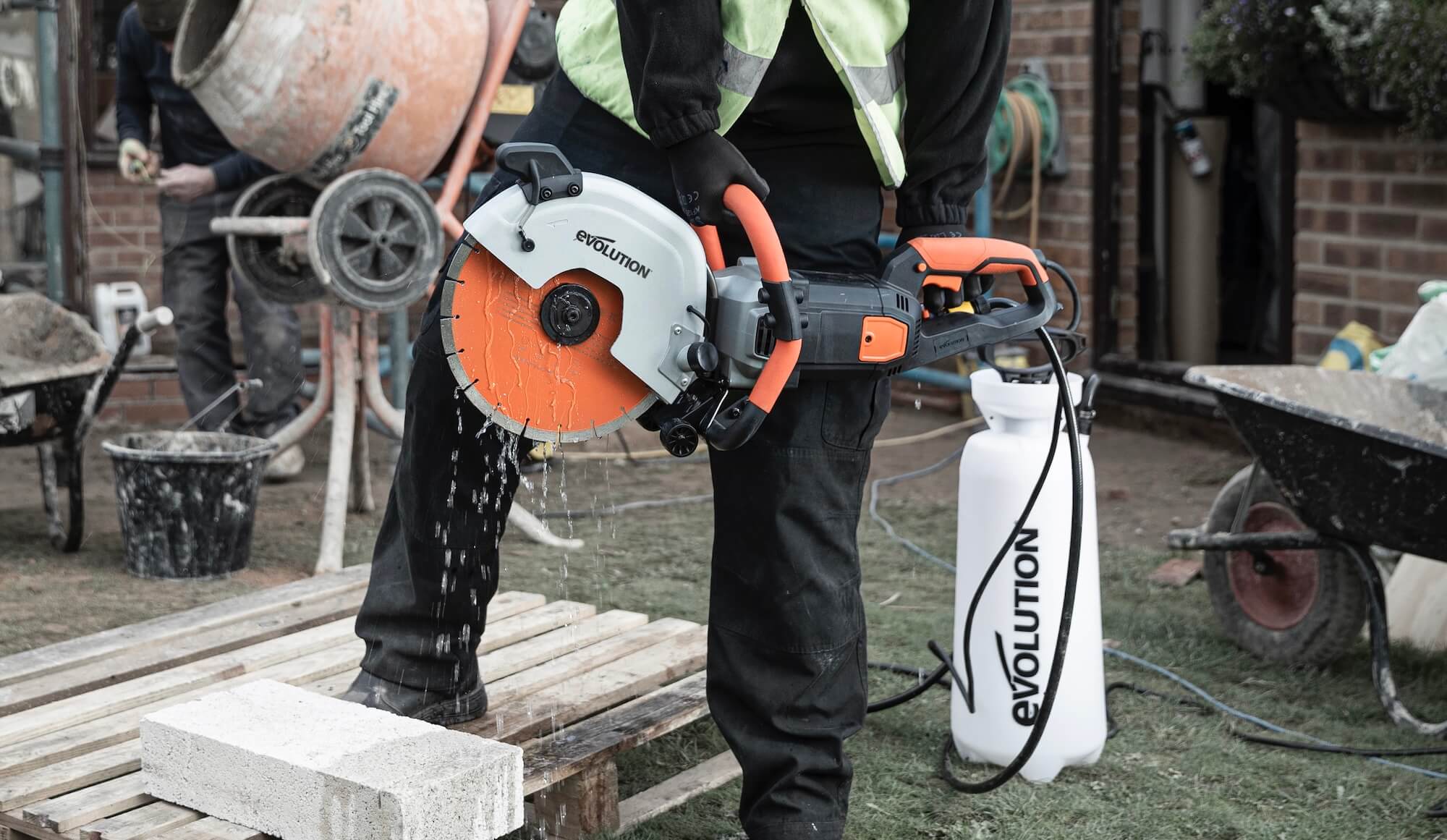
Concrete and construction dust can pose health risks. Using concrete saws with water suppression significantly reduces dust levels and adds lubrication for easier cutting and extends blade life.
Evolution’s R300DCT+ is equipped with on-board water suppression. All our water fed saws can be supplied from a appropriate respiratory protective equipment (RPE) like FFP3 masks or half masks with P3 filters.
6. Additional Features to Consider
-
Blade Guards: These are an essential safety feature to mitigate dust production and maximize visibility of the cut surface. All Evolution concrete saws feature large, angle adjustable blade guards for maximum protection.
-
Wheeled Skid Plates: Wheels underneath the concrete saw help you make straight cuts and reduce the strain when bending over to make long cuts at ground level. Their placement also allows the tool to be put down safely before the blade has stopped spinning. All Evolution concrete saws feature wheeled skid plates.
-
Electronic Brake Control: Stops the blade in seconds, enhancing safety. This important feature comes as standard on every Evolution concrete saw.

Final Thoughts
Choosing the right concrete saw doesn’t have to be overwhelming. By assessing your project requirements, understanding the different features, and exploring your options, you can find the perfect tool for the job. With the right concrete saw, you’ll tackle all your cutting tasks with confidence and efficiency! Click here to find out more about the Evolution Concrete Saw range.



 Saw Blades


 Parts & Accessories


