Official
Store
Store

Owning a table saw can revolutionize your workshop and any serious woodworker or DIY’er will eventually want to add one to their toolkit. Whether you are thinking about buying a table saw, have one already, or you want to get the best out of your saw, our beginner’s guide is perfect for you

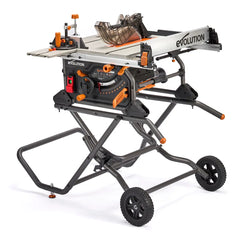
Why Choose the Evolution TBL+ Table Saw?

A table saw is a versatile woodworking tool used primarily for cutting large boards and making precise joints. Unlike a miter or circular saw, you move the material to the blade, which offers more control, - especially for larger workpieces.
Table saws have adjustable blade heights so you can set different cut heights for both full and partial depth (trench) cuts. You can also angle the blade to provide accurate bevel cuts and include mitre guides/sliding bed inserts that allow for compound cuts.
A table saw is considered a staple in the workshop. They are an excellent addition where accuracy and versatility are needed, especially if you are working on larger projects or using them for repetitive cutting. We cover some of the main pros and cons below.
Choosing the correct saw for the job can have a huge impact on the efficiency and standard it’s completed to. A table saw is often compared to a miter saw, circular (track) saw or band saw. When selecting the right saw, understanding the differences is essential. Here's a quick comparison:
|
Tool |
Best For |
Key Advantages |
Limitations |
|
Table Saw |
Long rip cuts in large materials Creating joints |
Controlled material movement & repetitive accuracy |
Less portable. Risk of kickback |
|
Miter Saw |
Accurate angle cross cuts and bevel cuts |
Easy to use for angled cuts, accurate and safe |
Limited board size and cut capacity |
|
Track Saw |
Long straight cuts on large pieces of wood |
Portable, accurate rip cuts. Normally the cheapest option |
Slower for repeat cuts. Track or guide is required for accurate straight line cuts |
|
Band Saw |
Curves, irregular shapes in large boards |
Cuts curves and resaws well. Less kickback than table saws |
Not ideal for long rips or straight lines. Blade change is time consuming |
Table Saw terminology can be confusing for the beginner. Here we break down the key features of a table saw and demystify some of the jargon you will commonly come across.

A sled is designed to support the workpiece and guide it smoothly through the blade. It is used to make accurate, consistent and repeatable cuts. It’s especially useful on cross cuts (cutting across the wood grain), and to reduce the risk of tear-out (wood splitting across the cut line).
A miter gauge allows a table saw to make cuts at a variety of different angles. This generally works alongside a rip fence and often a top clamp that secures the piece being cut.

A push stick is used to push your work piece over the blade. It replaces the need to put your hand near the blade, reducing the risk of any accidents.

When the piece you’re cutting is larger than the table, it can bend, especially if the material is thin. This could cause the workpiece to fall, catch or fly off. A table support extends beyond the saws main table. These are often adjustable and allow for better control when cutting large or wide boards. It helps the piece stay flat which makes the cut more accurate and the saw safer to use.

A riving knife is a safety device that is designed to prevent the workpiece jamming which could cause a kickback. It sits behind the blade and creates a constant kerf (the space created by the saw blade).

A blade guard is another table saw safety device. It’s normally a plastic cover that fixes to the riving knife and covers the majority of the blade. They are often clear, so the user can still see the blade while operating the saw. The blade guards purpose is to prevent fingers (and other foreign objects) from getting too close to the rotating blade.

The throat plate is an insert that covers the blade opening on the table. This allows the blade to pass up and through the table, while also leaving enough room for it to bevel. The gap in the plate is small to prevent small pieces of debris making 2nd contact with the blade. It’s removable to allow you to clear out the blade housing of any small pieces of debris that do fall down.

The rip fence is a cutting guide when using the saw. Its purpose is to help keep your material straight which will improve cutting accuracy. Ensuring the fence is securely fixed to the rails before use will help prevent your wood from moving, which could trap the blade and cause kickback.
Different table saws come with different rip fence adjustment systems. Our TBL range all have a Rack & Pinion system, which are considered by many experienced woodworkers to be preferable to alternative slide systems. Rack and Pinion systems are known for durability, precision and ease of adjustment.

While a table saw isn’t the most mobile of saws, it is versatile. Being able to move the material to the blade rather than taking the blade to the material, and having practically no size restrictions, means you can complete lots of different cuts, and create lots of different joints.
A popular technique used to create a flush finish, commonly found in flooring, cladding and wall panelling.
Advantages:
Disadvantages:

Known for its exceptional structural integrity, mortise and tenon joints are used in furniture making, typically tables, chairs and beds. Using a right angle to join two pieces of wood together, this woodworking method has been used for thousands of years.
Advantages:
Disadvantages

Miter joints are a common joint where two pieces of wood are cut at an angle (usually 45 degrees) and joined together to create a clean finish. Typically used to create picture frames, door trims and molding giving a seamless finish.
Advantages:
Disadvantages:

A finger joint, also known as a box joint or comb joint is a woodworking method that interlocks two pieces of wood together. Typically this woodworking technique is used to create boxes, cabinets and drawers and is even used to create longer pieces of material.
Advantages:
Disadvantages:

A rip cut is a straight cut along the grain for narrowing boards.
A crosscut is when you cut across the grain. Mainly for shortening boards.
Both cuts are mainly used for narrowing boards.
To make these joints, you’ll need to use a rip fence, a miter gauge, and maybe additional accessories. It’s critical that these pieces of equipment are used for accuracy, as well as safety.

For many woodworkers, the table saw is at the heart of the workshop, but it’s also the tool that causes the most injuries. Cuts and amputations are a real risk, as is kickback - which is when a piece of wood gets thrown back towards the user's side of the saw.
So, whether you are thinking of buying a table saw, or are an experienced table saw user, make sure you read our separate blog called Table Saw Safety Tips.
We’ve summarised and listed our Top 10 health and safety tips below:
Accurate setup is essential for safe, high-quality work. A properly aligned table saw is one of the most accurate machines you will ever operate. If your saw’s components aren’t accurately aligned your cuts won’t be accurate.
All table saws will need an element of set up and calibration before first use.
Tools You’ll Need:
Steps:
The R255TBL+ stands out as one of the top-rated jobsite table saws on the market, blending precision, power, portability, and safety at a price point well under that of the big brands. Here’s why it’s a compelling choice for both pros and serious DIYers:


A three-day garden transformation that became something far more meaningful. Follow Zoe’s story a...
April 29, 2026

Our motto says it all: “One saw, one blade, cuts all.” Let’s dive into what makes our multi-mater...
February 04, 2026

You might notice something different about us. We’re excited to reveal a fresh new look and an am...
February 04, 2026

A staple saw for both trade professionals and DIY enthusiasts tool kits, we dive into the circula...
January 15, 2026

Owning a table saw can revolutionize your workshop and any serious woodworker or DIY’er will even...
October 29, 2025

Evolution Power Tools is proud to announce that we’ve won two 2025 Pro Tool Innovation Awards.
September 29, 2025

August 26, 2025

Whether you’re a seasoned professional or a DIY enthusiast, choosing the right concrete saw can g...
April 24, 2025

Looking for the perfect concrete saw? Whether you're cutting bricks, concrete, metal, or stone, c...
March 04, 2025

March 25, 2021
 Saw Blades


 Parts & Accessories